Reflexões de um Caracol à Beira da Estrada
Será a experiência estética a experiência do mundo.... o devir é um devir estético... ou será que devo atravessar a estrada?
sexta-feira, março 06, 2009
Brothers share wife to secure family land
From CNN's Sara Sidner

HIMACHAL PRADESH, India (CNN) -- Amar and Kundan Singh Pundir are brothers. Younger brother Amar breaks rocks in a mine for a living. Kundan farms their small piece of inherited land. They live in a beautiful but remote hillside village in the clouds of Himachal Pradesh, India.
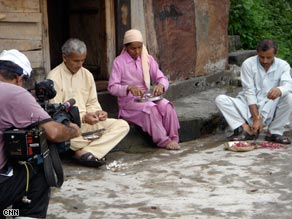

Kundar Singh Pundir, left, and his brother Amar, right, share Indira Devi, centre, as their wife.


Kundar Singh Pundir, left, and his brother Amar, right, share Indira Devi, centre, as their wife.


Both aged in their forties, the two brothers have lived together nearly their whole lives. They are poor and share just about everything: Their home, their work and a wife.

"See we have a tradition from the beginning to have a family of five to 10 people. Two brothers and one wife." Kundan says.

They practice what is known as fraternal polyandry -- where the brothers of one family marry the same woman. Why? Tradition and economics.

Life is hard here. The village is precariously perched on the side of a very steep hill about 6,000ft up. Most of the villagers survive off tiny plots of cropland.

In this difficult terrain there isn't enough land to go around. So, instead of finding separate wives and splitting up their inherited property, the brothers marry the same woman and keep their land together.

Wife Indira Devi says life with two husbands isn't easy.

"We fight a lot."

But like any married couple they fight mostly over mundane stuff, except there are three spouses instead of two.

"Usually it's about chores, why didn't you do this? Why didn't you do that?" she says. Video Watch Sara Sidner's interview with the brothers »

One thing they agreed on was the need to have children; They have three. So how does a married trio deal with sex?

"We make shifts, change shifts and sleep on alternate days. We have to make shifts otherwise it won't work," Kundan says.

"To run our families we have to do this, overcome the hurdles as well and then we have to control our hearts from feeling too much," Amar adds.

To outsiders their arrangement may seem odd, but in the village of about 200 it is the norm.

Typically the marriages are arranged and women have two husbands. But some wives have three or four depending on how many brothers there are in a family.

Polyandry is illegal in India but socially acceptable here. No one from the government seems to bother the villagers about the law.

"It's been going on for ages. My sister in law has two husbands, my mother in law also has two husbands," Indira says.

And as to the question of which husband is the biological father of the children -- the Pundir's don't know and don't care.

"For me everyone is the same, my mother and my fathers are the same. My mother and my fathers are like God to me," 17-year old daughter Sunita Singh Pundir says.

Even as modern society arrives in this ancient village through satellite dishes and mobile phones, the Pundirs say they want their age-old tradition to continue with their children.

"Absolutely," eldest son Sohna says.

He and his younger brother have already discussed it and will marry the same woman.

Daughter Sunita isn't so sure.

"I would like one husband," she says.

Etiquetas: , ,

posted by Mikasmokas @ 3/06/2009   0 comments
sexta-feira, agosto 03, 2007
Esta história merece algum destaque..


Prostitutas indianas lançam jornal 'Red Light Despatch'

Testemunhos e histórias pessoais são noticiadosDesafiando a marginalidade do bairro da luz vermelha (red light district) em Bombaim (Mumbai), um grupo de antigas prostitutas reúne-se todas as semanas num bordel para discutir as histórias que se publicaram nas páginas do jornal Red Light Despatch.Segundo o El Mundo, o periódico indiano nasceu há seis meses no bairro de Kamathiputra, um dos centros da vida nocturna da capital financeira da Índia. "Proporcionar um plataforma de expressão para as prostitutas" é o objectivo, explica o jornalista Anurag Chaturvedi, editor da publicação."O Red Light é a voz dos sem-voz e das mulheres sem identidade, porque ninguém discute os sonhos, as agonias ou as nostalgias das prostitutas: motivo pelo qual contamos as suas memórias, frustradas pela violência e pobreza", defende Chaturvedi.Uma modesta publicação de mil exemplares, oito páginas, sem fotos e a preto e branco, o Red Light é editado em inglês, hindu e bengali (idioma oficial do Bangladesh) e já ultrapassou as fronteiras de Kamathiputra."Chegamos a Calcutá, Nova Deli, Bombaim e à região de Bihar. Como ninguém reconhece a sua forma de vida, era claro que as prostitutas necessitavam de algum tipo de plataforma", explica o editor. "Assim sendo, pensámos porque não lançar um jornal feito por e para elas?"Na publicação há espaço para testemunhos e histórias pessoais, poemas, assuntos de saúde e direitos humanos, mas também para artigos como o texto escrito por Shirin Ebadi, Prémio Nobel da Paz, publicado num dos últimos números. Apesar de reconhecidos colunistas, a grande mais-valia do periódico está na sua capacidade de dar a conhecer o mundo das prostitutas, a quem o Governo índio, segundo Chaturvedi, nem sequer reconhece a cidadania.Com a ajuda da Apne Aap, organização não governamental (ONG) que luta pelos direitos da mulher, as prostitutas, reunidas na sua pequena redacção de Kamathiputra, "lutam" com as teclas - elas não sabem ler - com um objectivo comum: evitar que outras mulheres caiam no mesmo erro que elas."Há que criar a consciência entre as mulheres, que caem sem querer nas redes daqueles que as retiram das suas povoações com promessas de trabalho, e são logo arrastadas para este tipo de comércio", afirma a coordenadora do grupo, Rupa Metgudd, também proveniente daquele mundo.Com mais de dois milhões de trabalhadores do sexo na Índia, a prostituição está num limbo legal e considerada um tabu. Existe inclusivamente uma tribo, os Bedia, em que a prática de sexo por dinheiro é aceite como um trabalho da mulher.Na maioria dos casos, a profissão não é mais do que um último recurso ou um sequestro de que sofrem as jovens, pobres, que chegam às grandes cidades e são enganadas ou caem na tentação de obter dinheiro fácil. "Dei conta demasiado tarde de que tinha sido vendida a um bordel, sem retorno possível. Mas era a única forma de alimentar a minha família", escreve no jornal uma prostituta chamada Sita.- M.J.E.

http://dn.sapo.pt/2007/08/03/media/prostitutas_indianas_lancam_jornal_r.html

Etiquetas: , ,

posted by Mikasmokas @ 8/03/2007   0 comments
About Me

Name: Mikasmokas
Home:Lisboa
About Me:queria eu saber
See my complete profile
Previous Post
Archives
Shoutbox

nada a declarar

Links
Free Hit Counter
Free Counter

PageRank
Powered by

Blogger Templates

BLOGGER